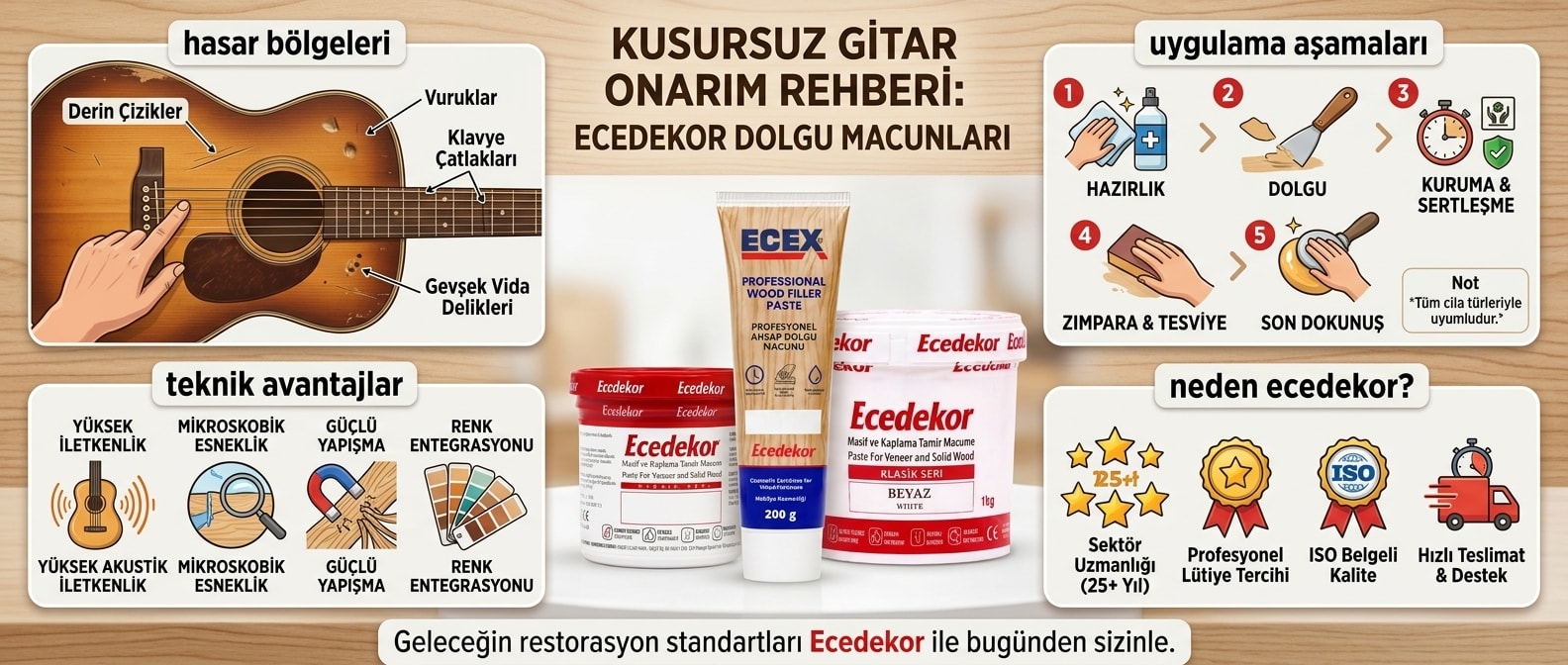
Musical instruments—especially guitars with wooden bodies—can wear out over time due to environmental factors, usage habits, and physical impacts. This wear and tear not only detracts from the instrument’s aesthetic appeal but can also affect its acoustic properties. At Ecedekor, we’re here to support you with the solutions we’ve developed to ensure you can maintain and repair your most valuable instruments to the highest standard.
Using ordinary filler materials for deep scratches, cracks, or broken pieces on wooden surfaces can negatively affect the guitar’s tone. This is where our guitar wood repair putty—specifically formulated for professional use—comes into play.
Repairs that preserve your instrument’s natural structure, do not hinder sound transmission, and maintain visual integrity extend the guitar’s lifespan. Developed in line with our vision for 2026, our innovative guitar wood repair putty—which delivers tomorrow’s restoration standards today—has become the top choice for both amateur musicians and professional luthiers (instrument makers).
In this comprehensive guide, we’ll detail the technical specifications of the specialized putties used in guitar maintenance, their application methods, and why you should choose Ecedekor quality.
What Is Wood Repair Paste for Guitars?
The guitar body, neck, and fretboard are made from special woods—such as rosewood, mahogany, ebony, and maple—that vary in density and resonance. These woods are living materials and react to changes in humidity and temperature. Standard furniture putty cannot adapt to these flexes once it hardens and will eventually crack or flake off over time. In contrast, wood repair putty for guitars must have the flexibility and density to adapt to the instrument’s natural vibration (resonance).
Backed by the Ecedekor guarantee, these products do more than just fill gaps; they integrate with the wood to ensure uninterrupted sound transmission. Especially in acoustic and classical guitars, every square millimeter of the body determines the character of the sound. Using the wrong filler material can cause the guitar to “lose its sound,” meaning the sound is dampened.
Wood repair putty used in professional restoration processes must be sandable, paintable, and varnishable once dry. It should not react with the guitar’s original finish (whether nitrocellulose or polyurethane) and should create a smooth surface. These putties restore the instrument’s structural integrity while preserving its aesthetic value.
Unlike traditional woodworking putties, putties produced for musical instruments have a much finer particle structure. This allows them to penetrate even the finest hairline cracks. Wood repair putty for guitars also comes in a wide range of color options, allowing you to perform a repair that perfectly matches your guitar’s natural wood tone.
Product Details and Technical Application Processes
The chemical and physical properties of the materials used in guitar maintenance and repair directly affect the success of the repair. The solutions we offer at Ecedekor have been developed with the precision requirements of instrument makers in mind. In this section, we will take an in-depth look at the product’s technical details and the correct application steps.
Chemical Composition and Compatibility
Our product caters to different needs with both water-based and solvent-based options. However, for guitars, special polymer-blended formulas that dry quickly and harden to the density of wood are generally preferred. This formula prevents the putty from shrinking over time (shrinkage).
Ordinary putties lose volume as they dry, causing the filled area to sink. Professional guitar wood repair putty, on the other hand, maintains the volume of the area where it is applied. Additionally, thanks to the special binders in its composition, it adheres to the wood without damaging the finish on the guitar.
Color Integration and Aesthetics
One of the biggest challenges in guitar repair is ensuring the repaired area doesn’t look like a patch. Wood grain patterns and color tones vary from guitar to guitar. For this reason, our putty is formulated to be easily mixed with pigments.
When mixed with the guitar’s own wood dust before application, it can produce a nearly invisible result. The color scale covers a wide range, from light maple tones to dark ebony black. This ensures flawless repairs even in the transition areas of burst-painted guitars.
Drying and Curing Process
The speed and quality of the repair depend on the curing time. Under optimal humidity and temperature conditions (approximately 20–25°C), our product becomes ready for sanding in 15 to 45 minutes, depending on the depth of the surface. The full curing (hardening) time is approximately 24 hours.
During this time, the putty penetrates the wood’s pores, creating a mechanical bond. Its fast-drying property speeds up luthiers’ workshop processes while allowing users to get their instruments back quickly.
Sandability and Leveling
Leveling the dried putty (surface smoothing) is the most critical stage of the repair. Our wood repair putty for guitars has a structure that does not clog sandpaper and wears down as it turns to dust.
Very hard putties can cause excessive wear on the surrounding soundboard wood during sanding. Our formula, however, is balanced to have a hardness similar to that of the guitar’s body wood. This prevents surface rippling during sanding and ensures a smooth transition.
Key Features
The repair putties in the Ecedekor product line stand out from ordinary fillers by addressing the specific needs of musical instruments. The key features sought by guitarists and luthiers are as follows:
High Acoustic Conductivity
A guitar’s body functions like a speaker cabinet. Vibrations from the strings are transmitted to the body via the bridge. If the material in the repaired area absorbs (dampens) the sound, the guitar’s sustain (the duration of the sound) is reduced. Wood repair putty for guitars, thanks to its crystalline structure, transmits vibrations rather than absorbing them. This allows for repairs to be made without any loss of tone.
Flexibility and Durability
Wood is a material that expands and contracts depending on the humidity in the environment. Especially during seasonal changes, the neck and body alignment of guitars can shift. Our putty possesses microscopic flexibility that adapts to these micro-movements. Although it hardens, it is not brittle; this prevents cracks from reopening.
Strong Adhesion
It’s not enough for the putty to simply adhere to the surface; it must integrate with the wood fibers. Our product’s high adhesion ensures that the repaired section stays securely in place, even in areas subject to impact. This feature is especially critical for repairs near the bridge and neck joint areas.
Compatibility with Varnishes and Lacquers
Guitar paints (polyester, polyurethane, nitrocellulose) are chemically sensitive. Some putties can cause the paint to blister or dissolve due to the solvents they contain. The putties we offer at Ecedekor can be safely used with any type of guitar lacquer and provide a flawless finish when a topcoat of varnish is applied.
Uses and Application Areas
Wood repair putty for guitars can be used on damage that may occur on nearly any wooden part of a guitar. However, each area has its own specific characteristics.
Body Damage
On acoustic guitars, the soundboard (front panel) is the most sensitive and most vibrating part of the instrument. When filling cracks or holes that form here with putty, the goal should be to minimize any increase in weight. In electric guitars, dents on the solid body may be deeper and may require layered filling.
Neck and Headstock Repairs
A smooth back on the neck is essential for playability. Even the slightest indentation where the thumb rests can affect the guitarist’s performance. In repairs to this area, it is important that the putty be sanded smooth to achieve a satin finish.
Fretboard Maintenance
The guitar’s fretboard is usually unvarnished and is directly exposed to finger contact, sweat, and oil. Cracks in rosewood or ebony fretboards, or breaks caused during fret replacement, should be repaired with putty that matches the wood’s color. The putty used here must be extra resistant to finger friction.
Bridge and Nut Area
Loose screws or wood warping in the bridge area—where string tension is highest—require structural reinforcement. Our filler also provides high strength during the process of filling and re-drilling screw holes.
Application Example 1: Removing Deep Scratches on the Body
Deep scratches on a guitar body typically penetrate past the varnish and reach the wood. This type of damage is not only visually unsightly but can also cause the wood to absorb moisture.
Preparation and Cleaning Stage
As a first step, the area around the damaged section should be protected with masking tape. The inside of the scratch must be cleaned of dirt, varnish residue, and oils. Special cleaning solutions or isopropyl alcohol can be used for this purpose. Lifted varnish pieces along the edges of the scratch are removed with a fine scalpel or sandpaper, creating a surface where the wood repair putty can adhere properly.
Layered Filling and Leveling
For deep scratches, it is better to apply the putty in layers rather than filling the entire scratch in one go. The first layer is applied to the bottom of the scratch and allowed to dry. Then, the second layer is applied so that it rises just slightly above the surface level. Once fully dry, the surface is sanded down to the guitar’s original level using a sanding block (in the order of 400, 800, and 1200 grit). In the final step, polishing is performed to completely eliminate any traces of the repair.
Application Example 2: Repairing Fretboard Cracks
In dried-out wood, especially during the winter months, cracks may form in the fingerboard due to lack of moisture. Over time, these cracks can grow and cause the frets to shift out of place.
Color Matching and Mixing
Since the fretboard is usually unpainted, the color of the filler used is of critical importance. Wood repair filler for the guitar is mixed with sanding dust from the relevant wood species (e.g., rosewood) to achieve the proper consistency. This method ensures that the texture and color of the filler match the rest of the fingerboard exactly.
Filling Cracks and Oiling
The prepared mixture is worked into the crack using a thin spatula or plastic card. Any excess must be removed immediately before it dries. Once the putty has dried, it is sanded with 0000-grit steel wool or very fine sandpaper. At the end of the process, lemon oil or special keyboard care oils are applied to ensure the repaired area blends seamlessly with the wood and is properly nourished.
Application Example 3: Repairing Stripped Screw Holes
Strap buttons or pickguard screws can loosen over time, causing their holes in the wood to widen. This prevents the screw from holding securely.
Hole Filling Technique
For this process, first clean out the inside of the hole. Inject guitar wood repair putty into the hole using a syringe or a fine-tipped applicator until it is completely filled. If the hole is very wide, a thin wooden toothpick or splinter can be used as a support along with the putty. This increases the putty’s strength.
Re-drilling and Assembly
Once the putty has fully cured (it is generally recommended to wait 24 hours), a pilot hole is drilled using a drill bit slightly smaller than the screw’s diameter. This pilot hole allows the screw to advance without splitting the wood (or the hardened putty). As a result, the screw holds just as securely as on the first day, and the part is safely assembled.
Application Example 4: Restoration of Chips on the Headstock Corners
One of the areas of a guitar most prone to impact is the sharp corners of the headstock. Small pieces of wood that break off from this area create an unsightly appearance.
Mold Making and Filling
If the broken piece is missing, the area must be rebuilt using putty. To prevent the putty from running and to ensure it takes the correct shape, a temporary mold or form is created using masking tape. Wood repair putty for guitars is applied thickly into this mold. Care must be taken to ensure no air bubbles remain.
Shaping and Finishing
Once the putty has dried, the masking tape is removed. The resulting rough shape is shaped using files and sandpaper to match the original curves of the headstock. Once the shaping is complete, the area is touched up with the appropriate color paint and a coat of varnish is applied to finish the repair. Although this process requires patience and manual dexterity, the putty’s malleability makes the job much easier.
Frequently Asked Questions
Users often have many questions about the chemicals and filler materials used in guitar maintenance. Below, you’ll find the questions we encounter most frequently and the expert answers to them.
Does the putty change the guitar’s sound?
No, it does not, when applied correctly. The products offered by Ecedekor are formulated to reach a density similar to that of guitar wood once dry. They do not dampen acoustic vibrations; rather, they ensure the continuity of sound transmission. The tonal character is preserved even in large-scale repairs.
Can paint or varnish be applied over the putty?
Absolutely. Our product is paintable. It is compatible with virtually all types of paint and varnish used in guitar making, including water-based, acrylic, polyurethane, and nitrocellulose. However, before painting, you must ensure that the putty is completely dry and that the surface has been sanded smooth.
Can I use this putty on an electric guitar?
Yes, this wood repair putty for guitars is suitable for acoustic, classical, electric, and bass guitars. It can be safely used to repair dents in solid-body electric guitars or to fill cracks on the back of the neck.
How long does the putty take to dry?
The drying time varies depending on ambient temperature, humidity, and the thickness of the applied putty layer. While superficial fills may be ready for sanding in 15–20 minutes, it is recommended to wait 24 hours for deep fills to fully cure. Rushing the process may cause the putty to sink later on.
What is the product’s shelf life?
When kept with the cap tightly closed and stored in a cool, dry place, our products retain their freshness for a long time. If the paste hardens slightly over time, it can be restored to its original consistency by adding a very small amount of water, depending on the type (if water-based). However, for best performance, we recommend using the product while it is fresh.
At Ecedekor, with our respect for music and musical instruments, we continue to offer you the highest-quality repair materials. You can choose our professional solutions to preserve the value of your guitar and give it the care it deserves.