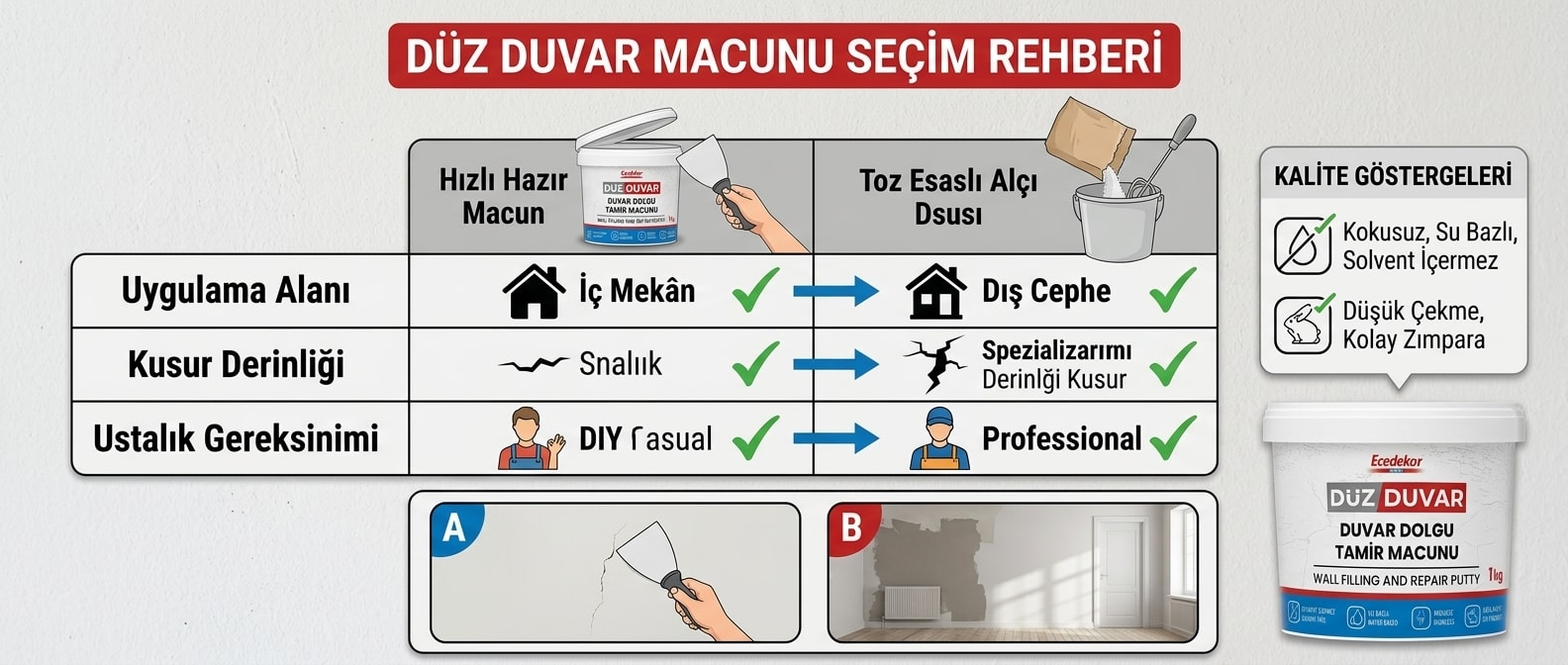
Four criteria are key when selecting a wall filler: the application area (indoor/outdoor), the depth of the defect, the filler’s form (ready-to-use or powder), and the finish to be applied over it. Ready-to-use, water-based putties are the most practical solution for repairing cracks and holes indoors; for exterior walls, however, moisture- and sun-resistant formulas are required. This guide explains all the criteria in a comparative format to help you choose the right wall putty.
Selection Criteria
1. Indoor or Outdoor?
For indoor use, the priorities are ease of application, quick drying, and odorlessness. A water-based, solvent-free, and odorless putty can be safely used in all living spaces, including children’s rooms. For exterior surfaces exposed to rain, frost, and sunlight (UV), flexible, water-repellent exterior fillers are essential—interior putty will crack and flake off outdoors within a short time.
2. Type and Depth of the Defect
- Hairline cracks and fine marks: A fine-textured, ready-to-use putty that sands easily.
- Screw and anchor holes, medium cracks: Standard wall repair putty; a single-product solution.
- Deep voids and breaks (5 mm+): A low-shrinkage filler suitable for layered application; for very deep voids, apply repair mortar first, followed by a thin layer of putty.
- Wall-to-wood joints: Use a flexible joint filler instead of a hard putty (different expansion rates can cause cracking).
For details on application techniques, see our guide to filling wall cracks and holes.
3. Ready-to-Use or Powder?
| Feature | Ready-to-Use (Putty) | Powder (Satin/Plaster-Based) |
|---|---|---|
| Preparation | None — just open the lid and apply | Mixing with water, adjusting the ratio |
| Fire | Minimal; close the lid, then use | The mixed portion cannot be left to stand |
| Consistency | Factory setting, same every time | Requires skill |
| Wide-surface application | Ideal for spot repairs and touch-ups | Cost-effective for satin plastering of entire walls |
| Typical user | Spot repairs, touch-ups before painting | Professionals preparing entire walls |
Summary: A ready-to-use putty for repairing cracks and holes and for pre-paint touch-ups; if you’re covering an entire wall with satin plaster from scratch, powdered products are more economical. The two are not competitors—they are complementary.
4. Topcoat
If the wall is to be painted after repair, the putty’s paint adhesion is important: a surface that is easy to sand after drying and absorbs primer/paint evenly is desired. If wallpaper is to be applied, the surface must be completely smooth and dust-free; priming the spackled areas balances the absorption of the adhesive.
Features That Distinguish High-Quality Wall Spackle
- Low shrinkage: It does not shrink when dry, reducing the need for a second coat.
- Easy to sand: Putty that hardens excessively wastes time during sanding.
- High adhesion: Adheres to plaster, stucco, concrete, and painted surfaces.
- Odorless / Solvent-Free: Safe for use in enclosed spaces (water-based formula). Ecedekor putties contain no harmful chemicals and are vegan-friendly.
- Crack resistance: Its slight flexibility prevents hairline cracks from reopening.
Ecedekor wall putties have been produced since 1998 at our facilities—which have been manufacturing wood and wall fillers—using water-based and eco-friendly formulas; browse the wall putty category for all varieties.
For Professionals and Dealers: Wholesale Selection
The right product mix for painting and renovation teams and home improvement store dealers: 1 kg ready-to-use wall repair putty for intensive touch-up work + various wood filler putties for wood repairs. On the Ecedekor B2B platform, dealers benefit from wholesale pricing, 30/60/90-day payment terms, and nationwide shipping in Turkey; the dealership application takes just a few minutes.
Frequently Asked Questions
Is wall filler the same as satin plaster?
No. Satin plaster is a powder-based finishing material used to cover the entire wall surface with a thin layer; wall filler, on the other hand, is a ready-to-use repair product designed to fix cracks, holes, and minor imperfections. Putty is the right choice for touch-ups before painting, while satin plaster is the right choice for complete surface renewal.
Can interior wall putty be used on exterior walls?
It should not be used. Interior formulations are not resistant to rain, frost, or UV exposure; they will crack and flake off outdoors within a short time. For exterior walls, choose water-repellent, flexible exterior fillers.
Is there odorless wall putty?
Yes. Water-based, solvent-free putty is odorless and can be safely applied indoors—including in children’s rooms. Ecedekor Smooth Wall Putty falls into this category.
What kind of paint can be applied over wall putty?
Water-based interior paints can be applied without any issues over putty that has fully dried and been sanded. For large repairs, using a primer before painting prevents visible differences caused by varying absorbency in the repaired area.
How much area can 1 kg of putty repair?
For spot repairs (screw holes, hairline cracks), 1 kg of putty can cover dozens of imperfections; for continuous filling at a depth of 3–5 mm, it covers approximately 0.5–1 m². Consumption varies depending on the depth of the defect; refer to the consumption information on the product label for exact values.
Where can I buy wall putty in bulk?
Purchasing directly from the manufacturer in bulk is the most economical option. On the Ecedekor B2B platform, you can place orders at wholesale prices after applying for a dealership and take advantage of installment payment options.